Hunjan Hospital Ludhiana
Hernia Repair
Hernia repair: types of hernia, how open and keyhole repairs are done, when surgery is recommended, recovery ranges, risks and emergency warning signs.

What a hernia is
A hernia happens when part of an internal organ, such as the bowel, pushes through a gap or weak area in the muscle that keeps the organs in place.[1] Most hernias develop in the tummy (abdomen) or groin. Many cause a lump that may get bigger when you cough or sneeze and smaller when you lie down.[1] Common types include:
- Inguinal hernia: in the groin, where the leg joins the abdomen[1]
- Femoral hernia: in the upper thigh near the groin; more common in women[4]
- Umbilical hernia: under or near the belly button[1]
- Incisional hernia: at the scar of a previous abdominal operation
Hernia repair is planned after a surgeon has examined you. Most groin hernias can be diagnosed by examination alone; occasionally a scan is needed.[5]
How hernia repair is done
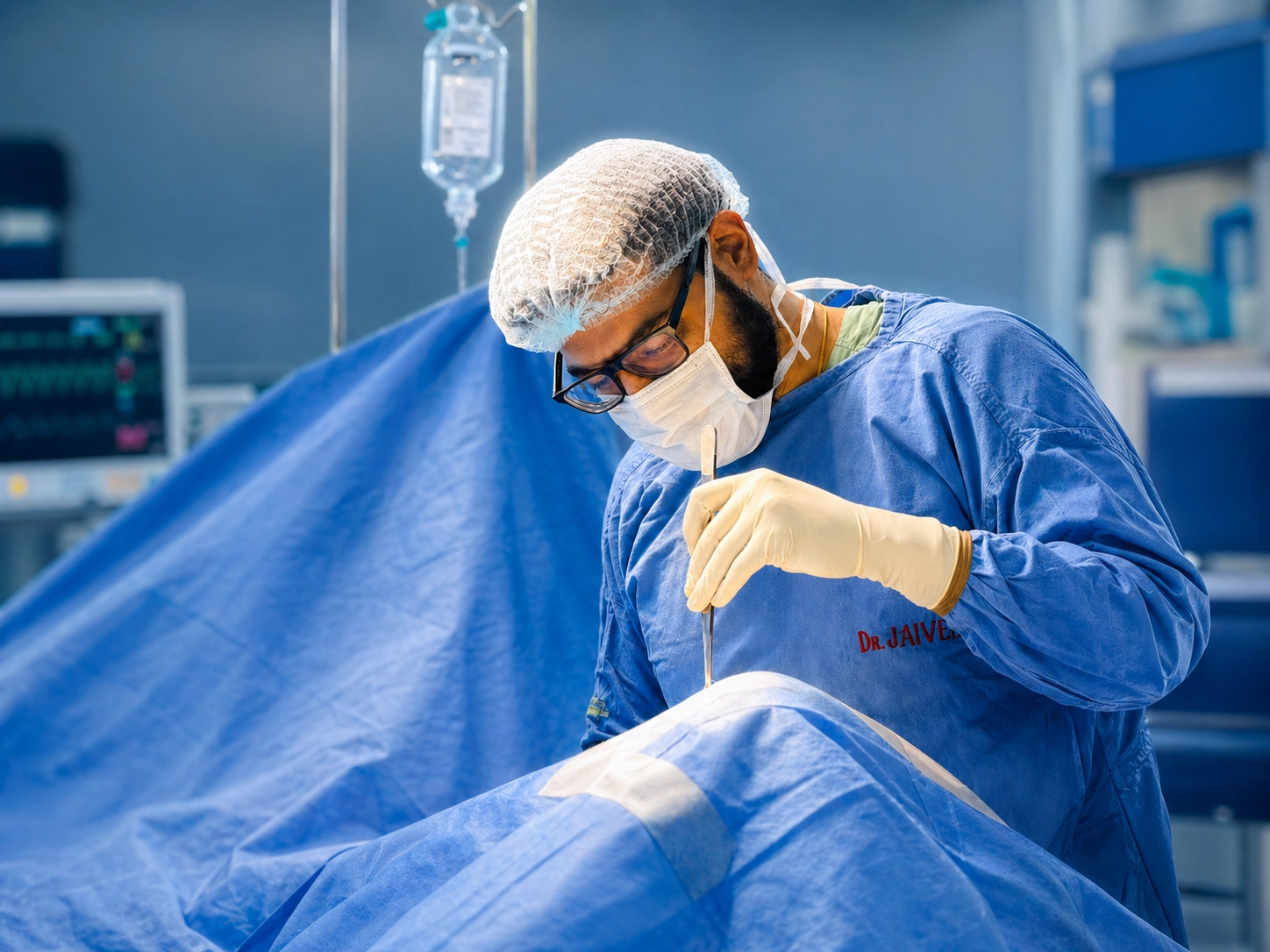
Repair can be done in two main ways: keyhole (laparoscopic) surgery through a few small cuts, or open surgery through one larger cut.[2] The hernia is pushed back into place and the weak area is strengthened, usually with a thin sheet of mesh fixed with small stitches; sometimes stitches alone are used.[2] International guidelines recommend mesh repair as the first choice for groin hernias, using either the open or the keyhole approach.[5]
You will have either a general anaesthetic, where you are asleep, or a local anaesthetic, where you are awake but the area is numb.[2] A groin hernia repair usually takes 30 to 90 minutes,[2] and an umbilical hernia repair 30 to 60 minutes.[3]
The type of repair offered depends on where the hernia is, its size and your general health,[2] and on whether it is on both sides or has come back after a previous repair.[7] Your surgeon will discuss the risks and benefits of each approach with you.[7]
Signs of a hernia emergency
Sometimes part of the bowel becomes stuck in a hernia (obstruction) or trapped with its blood supply cut off (strangulation). Strangulation is a medical emergency that needs surgery as soon as possible.[3,4]
Get urgent medical advice if you have a hernia and develop pain in or around it, a bloated tummy, constipation or a high temperature.[1] Call 112 or go to the nearest emergency department[9] if you have a hernia and:
When repair is recommended
A hernia does not always need an operation straight away. The decision depends on the type of hernia, your symptoms and your general health. In general:
- Groin hernias that cause symptoms, such as pain, should be repaired[5]
- Repair can prevent a hernia causing a bowel blockage or strangulation[2]
- Men with an inguinal hernia that causes few or no symptoms may choose "watchful waiting", because the risk of an emergency is low; most eventually need surgery[5]
- Femoral hernias are usually repaired soon after diagnosis, because they carry a higher risk of complications[4]
- Umbilical hernias in adults are usually repaired, because they are unlikely to get better on their own[3]
- In young children, umbilical hernias usually disappear by the age of 5 without treatment[3]
Keyhole and open groin hernia repair compared
These findings come from pooled trials comparing the two approaches.[6] International guidelines also report faster recovery and a lower risk of long-term pain with keyhole repair where the expertise and resources are available.[5] NICE advises that keyhole repair should be done by surgeons trained in it who perform it regularly, and that the choice should follow a full discussion of risks and benefits.[7]
Typical recovery
For groin hernia repair. Recovery varies with the type of repair, the size of the hernia and your work.
- Day of surgery
Going home
Most people go home the same day.[2] Someone should stay with you for the first 24 hours after a general anaesthetic.[8]
- First few days
Early recovery
Pain around the wound for a few days, some bleeding from the wound for a couple of days, and bloating or shoulder pain after keyhole surgery are normal. Keep moving and walk gently.[2]
- 1 to 2 weeks
Wound healing and work
Bruising or swelling can last a couple of weeks, and the wound usually heals in about 2 weeks. Many people return to work after at least 1 to 2 weeks, or up to 6 weeks if their job involves heavy lifting.[2]
- 4 to 6 weeks
Full recovery
Avoid heavy lifting and strenuous activity for at least 4 to 6 weeks. Recovery usually takes 4 to 6 weeks, but it can take longer.[2]
Risks and possible complications
Complications after hernia repair are uncommon,[2] but it is important to know about them before deciding.
- Wound infection[2]
- A lump or swelling where the hernia was, which can last a few weeks or months[2]
- A large, painful bruise in the groin or genitals, which can last a few months[2]
- Long-lasting groin pain or numbness. About 10 to 12 in 100 people have clinically significant pain after groin hernia repair, which tends to decrease over time; pain that affects daily activities or work affects about 0.5 to 6 in 100[5]
- The hernia coming back[2]
- Damage to nearby structures, such as the bowel, bladder or blood vessels[2]
- Blood clots, such as DVT or pulmonary embolism[2]
- Anaesthetic side effects such as feeling sick or a sore throat; rarely, a serious allergic reaction[8]
Seek medical help urgently if the wound has pus or becomes painful, swollen, warm or red, you have a high temperature or shivering, a swollen or increasingly painful tummy, a lot of bleeding from the wound, are still being sick 24 hours after surgery, or have throbbing or cramping pain in a leg.[2] Call 112 or go to the nearest emergency department if you have chest pain, severe difficulty breathing or are coughing up blood.[2,9]
Questions about hernia repair
Charges and insurance
Treatment charges depend on clinical evaluation, the procedure, implant selection (where applicable), and room category. You can request an estimate after consultation before deciding on treatment. The hospital’s insurance desk assists with cashless pre-authorisation and reimbursement documentation for eligible policies — see the Insurance page.
Patient pathway
Hernia Repair treatment journey in Ludhiana
Patients receive a step-by-step clinical assessment focused on symptoms, diagnosis, treatment choices, recovery expectations, and follow-up care.
Consultation
The doctor reviews symptoms, history, current medicines, and previous reports.
Diagnosis
Imaging, lab tests, or specialist assessments may be advised when required.
Treatment plan
Options may include medication, therapy, minimally invasive care, surgery, or rehabilitation.
Recovery support
The team explains risks, recovery timelines, warning signs, and follow-up steps.
References
Sources are provided for general information; a qualified clinician can advise on your situation.
- Reference 5: International guidelines for groin hernia management(opens in a new tab)
Hernia (HerniaSurge Group), 2018pubmed.ncbi.nlm.nih.govdoi:10.1007/s10029-017-1668-x
- Reference 6: Laparoscopic techniques versus open techniques for inguinal hernia repair(opens in a new tab)
Cochrane Database of Systematic Reviews, 2003pubmed.ncbi.nlm.nih.govdoi:10.1002/14651858.CD001785
- Reference 7: Laparoscopic surgery for inguinal hernia repair(opens in a new tab)
National Institute for Health and Care Excellence (NICE), 2004nice.org.ukTA83
- Reference 9: Helpline(opens in a new tab)
National Portal of India, Government of India, 2026india.gov.in
This page was prepared with AI assistance and is awaiting review by a hospital clinician.
Book an appointment with our team