Knee arthritis can gradually make everyday activities such as walking, climbing stairs, getting up from a chair and sleeping comfortably more difficult. For many people, symptoms can initially be managed with measures such as activity modification, physiotherapy, weight management, medicines or injections, depending on the underlying condition.
When arthritis becomes advanced and persistent pain or loss of function significantly affects daily life despite appropriate non-surgical treatment, total knee replacement may be considered after evaluation by an orthopaedic surgeon.
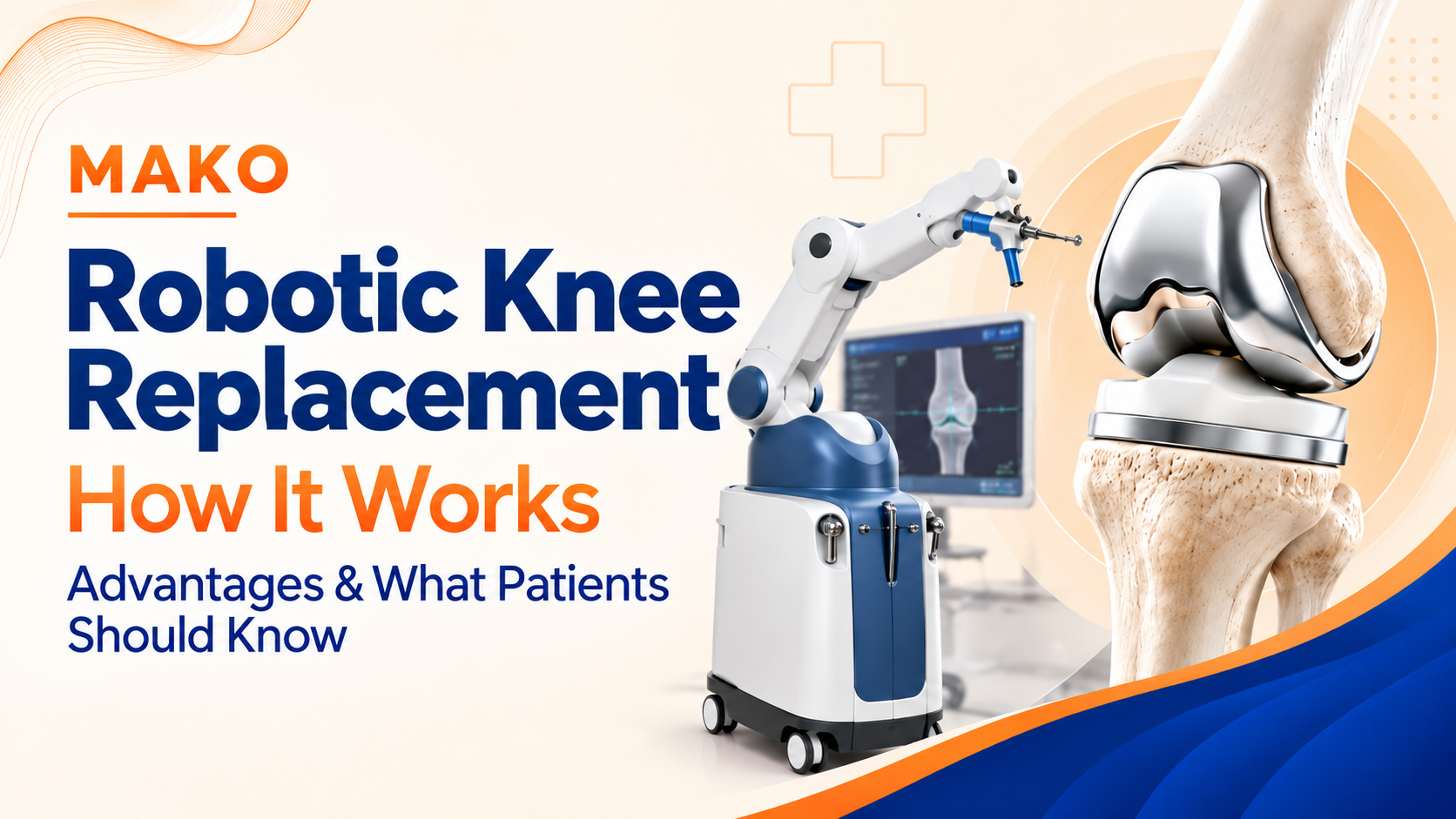
One advancement in knee replacement surgery is robotic-assisted total knee replacement, including the MAKO SmartRobotics™ system.
What Is MAKO Robotic Knee Replacement?
MAKO is a robotic-assisted surgical platform developed by Stryker. It combines 3D CT-based planning, real-time information during surgery and haptic robotic-arm technology to assist the surgeon in planning and carrying out selected parts of knee replacement surgery.
An important point for patients to understand is that the robot does not independently perform the operation. The orthopaedic surgeon remains in control of the procedure. The robotic system acts as a surgical tool that helps the surgeon execute the planned bone preparation and implant positioning within defined boundaries.
How Does MAKO Robotic Knee Replacement Work?
Before surgery, a CT scan is used to create a three-dimensional model of the patient’s knee. This allows the surgical team to assess the individual anatomy and prepare a personalised operative plan, including the intended size, position and alignment of the knee implant.
During surgery, the surgeon can assess factors such as knee movement and ligament tension and refine the plan where appropriate. MAKO’s haptic technology creates virtual boundaries designed to help the surgeon perform the planned bone cuts while limiting movement of the cutting instrument outside those boundaries.
The damaged joint surfaces are then replaced with the selected knee replacement components, just as in a total knee replacement procedure.
Potential Advantages of Robotic-Assisted Knee Replacement
1. More Individualised Surgical Planning
No two knees have exactly the same anatomy. CT-based three-dimensional planning provides additional information that can help the surgeon plan implant position according to the individual patient’s anatomy rather than relying solely on standard measurements.
2. Greater Precision in Executing the Surgical Plan
One of the most consistently demonstrated advantages of robotic-assisted total knee replacement is improved accuracy in implant positioning and limb alignment.
A 2025 systematic review and meta-analysis of 21 randomised controlled trials involving 2,692 patients found that robotic-assisted knee replacement resulted in fewer mechanical-alignment outliers and less deviation from the planned mechanical axis than conventional knee replacement.
This increased precision is an important technical advantage, although greater surgical accuracy does not automatically guarantee a better result for every patient.
3. Assessment of Knee Balance During Surgery
Successful knee replacement is not only about bone cuts. The relationship between the implant, ligaments and surrounding soft tissues also affects how the knee moves.
MAKO provides information that allows the surgeon to assess ligament tension and joint balance during the operation and modify the planned implant position when clinically appropriate.
4. Controlled Bone Preparation
The system’s haptic boundaries help keep the surgical cutting instrument within the planned area. Studies and manufacturer-referenced clinical data suggest robotic assistance can reduce unintended damage to surrounding bone or soft tissues compared with some conventional techniques.
5. Potential Early Recovery Benefits in Some Patients
Some studies have reported less early postoperative pain, reduced pain-medication requirements or earlier achievement of rehabilitation milestones following robotic-assisted knee replacement. However, these findings are not consistent enough to promise faster recovery for every patient.
Recovery remains affected by factors such as age, muscle strength, severity of arthritis, other medical conditions, surgical complexity, rehabilitation and adherence to physiotherapy.
Is Robotic Knee Replacement Better Than Conventional Knee Replacement?
The answer is more nuanced than simply saying yes.
Current research generally supports an advantage for robotic-assisted surgery in precision, alignment and the ability to execute a patient-specific surgical plan. However, studies comparing pain, function and patient-reported outcomes have produced mixed results.
For example, the 2025 meta-analysis of randomised trials found improved alignment accuracy with robotic-assisted knee replacement but did not find significant differences in commonly used WOMAC or Oxford Knee Scores during short- to medium-term follow-up. Robotic procedures also tended to require somewhat longer operating times.
Therefore, robotics should be viewed as an advanced surgical assistance technology, not as a replacement for an experienced orthopaedic surgeon or as a guarantee of a perfect result.
Who May Need a Knee Replacement?
Knee replacement may be considered in patients with advanced joint damage—commonly from osteoarthritis—when symptoms significantly affect quality of life and appropriate conservative treatment is no longer providing adequate relief.
Symptoms that may lead to an orthopaedic evaluation include persistent knee pain, increasing difficulty walking, pain during routine activities, stiffness or reduced movement, deformity of the knee and symptoms that continue despite appropriate non-surgical management.
The decision to undergo surgery should be based on the patient’s symptoms, clinical examination, imaging, medical condition, lifestyle and treatment goals rather than an X-ray finding alone.
What About Recovery After Robotic Knee Replacement?
Robotic technology does not remove the need for rehabilitation.
Patients are usually encouraged to begin mobilisation according to their surgeon’s and physiotherapist’s recommendations. Physiotherapy generally focuses on restoring knee movement, rebuilding muscle strength and gradually improving walking and everyday activities.
Recovery timelines vary considerably. Comparing one patient’s recovery with another’s can therefore be misleading.
MAKO Robotic Knee Replacement at Hunjan Hospital, Ludhiana
Hunjan Hospital in Ludhiana provides MAKO robotic-assisted knee replacement as part of its orthopaedic and joint replacement services.
The hospital reports more than 40 years of orthopaedic experience and 8,000+ knee replacements across its joint replacement practice. Dr. Balwant Singh Hunjan, MBBS, MS (Orthopaedics), M.Ch (Orthopaedics), leads orthopaedics and joint replacement, while Dr. Jaiveer Singh Hunjan, MBBS, MS (Orthopaedics), works in areas including arthroplasty, arthroscopy, sports injuries, trauma and robotic-assisted joint replacement. The hospital is also listed as NABH Pre-Accredited and provides physiotherapy and rehabilitation services.
For patients considering knee replacement, the first step should be a proper orthopaedic evaluation. The surgeon can determine whether surgery is actually required, whether robotic-assisted replacement is appropriate and which implant and surgical approach best suit the individual patient.
Hunjan Hospital
111 Kochar Market Road, South Model Gram, Ludhiana, Punjab
Call / WhatsApp: +91 85560 24365
Medical Disclaimer
This article is intended for general educational and awareness purposes only and should not be considered medical advice, diagnosis or a recommendation for surgery. Robotic-assisted knee replacement is not necessary or suitable for every patient. Benefits, risks, recovery time and outcomes vary according to the patient’s diagnosis, general health, anatomy, implant selection, surgical factors and rehabilitation. A qualified orthopaedic surgeon should evaluate the patient and discuss appropriate treatment options before any decision regarding knee replacement surgery is made.