What is Robotic Knee Surgery?
Robotic knee surgery is an advanced approach used in knee replacement procedures where robotic technology assists the surgeon in planning and executing the operation with a higher level of accuracy. It is important to understand that the robot does not perform surgery on its own. The procedure remains fully controlled by the surgeon, while the robotic system provides real-time guidance, precision measurements and support during critical steps of surgery.
In knee replacement, even small differences in alignment, implant positioning and soft tissue balance can influence comfort, movement and long-term function. Robotic assistance helps improve these aspects by allowing a more personalised surgical plan based on the patient’s anatomy.
At Hunjan Hospital, robotic knee surgery is part of a modern orthopedic approach focused on precision, recovery and long-term outcomes.
Why knee replacement has changed over time
Traditional knee replacement surgery has helped many patients regain mobility for years. However, advances in orthopedic science have shown that every knee is structurally different. Bone shape, alignment pattern, ligament tension and movement mechanics vary from person to person.
This is where robotic assistance becomes valuable. Instead of relying only on standard instruments and visual judgement, robotic systems allow surgeons to plan according to the patient’s individual knee structure.
- Better understanding of joint alignment
- More accurate implant placement
- Improved soft tissue balancing
- Greater consistency during surgery
- A more customised approach rather than a one-size-fits-all method
How robotic knee surgery works
Robotic knee surgery usually follows a structured process before and during the operation.
- Detailed assessment of the patient’s knee condition
- Imaging and planning to understand joint damage and anatomy
- Creation of a surgical plan based on individual measurements
- Real-time robotic guidance during bone preparation
- Assistance in positioning the implant accurately
- Intraoperative adjustments based on knee movement and balance
The surgeon remains in control throughout the procedure. The robotic system acts as an advanced tool that enhances decision-making and execution.

What makes it different from standard surgery
The main difference is not that surgery becomes automatic. The difference is that surgery becomes more data-guided.
In conventional surgery, alignment and placement depend on instruments and surgical experience. In robotic surgery, experience is still essential, but technology adds an extra layer of measurable precision.
- Implant placement can be more accurate
- Bone cuts can be more controlled
- Soft tissue balancing can be assessed dynamically
- The plan can be adjusted during surgery if needed
- Greater reproducibility from case to case
For patients, this may translate into better comfort, smoother movement and improved confidence in the new joint.
Who may benefit from robotic knee surgery
Robotic knee surgery is often considered for patients who have significant knee arthritis, persistent pain and reduced quality of life despite medication, injections or physiotherapy. It may be especially helpful in patients where alignment issues, deformity or complex joint wear need careful planning.
It is commonly considered in:
- Advanced knee arthritis
- Severe pain while walking or climbing stairs
- Stiffness affecting daily routine
- Bow-leg or knock-knee changes
- Cases where accurate alignment is especially important
- Patients seeking faster functional recovery with proper rehabilitation
The final suitability depends on clinical examination and imaging.
Common myths patients still believe
Myth 1: The robot performs the surgery alone
This is incorrect. The surgeon performs the operation. The robotic system assists with planning and precision.
Myth 2: It is only for marketing
Technology in surgery is adopted when it improves consistency and accuracy. Robotic systems are used because precision matters in joint replacement.
Myth 3: If the robot fails, surgery fails
The surgeon remains fully trained to continue and complete the procedure safely.
Myth 4: It is only for young patients
Suitability depends on knee condition, bone quality, overall health and functional goals, not age alone.
Recovery after robotic knee surgery
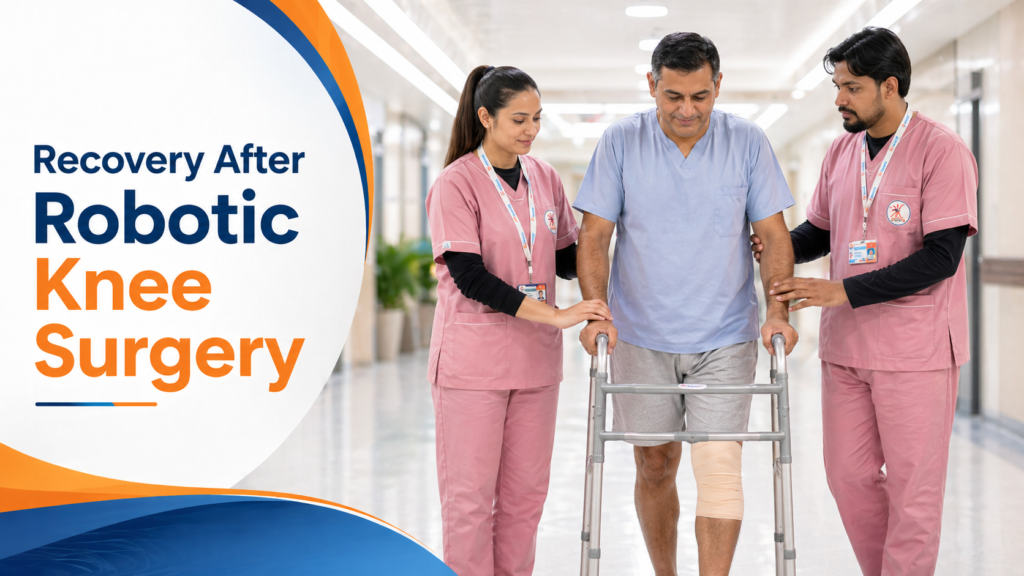
Recovery depends on surgical technique, pain control, physiotherapy, motivation and overall health. Robotic assistance can support better tissue handling and accurate placement, which may help recovery in selected patients.
Many patients focus only on the surgery day, but recovery begins immediately afterward.
- Early mobilisation is usually encouraged
- Walking may begin with support as advised
- Physiotherapy helps restore movement and strength
- Swelling control and pain management are important
- Daily activities improve gradually over weeks
- Long-term success depends heavily on rehabilitation
At Hunjan Hospital, the focus extends beyond the operation theatre to structured post-surgery recovery and guided physiotherapy.
Why surgeon experience still matters most
Technology does not replace surgical judgement. Robotic assistance is valuable only in experienced hands. Proper implant selection, handling of soft tissues, managing unexpected findings and decision-making during surgery all depend on the surgeon.
This is why choosing a hospital with both technology and experience is important. A robot is a tool. Outcomes depend on how well that tool is used.
Robotic Knee Surgery at Hunjan Hospital
Hunjan Hospital has built a strong reputation in orthopedic care with decades of experience in joint replacement. By integrating robotic knee surgery into clinical practice, the hospital combines surgical expertise with advanced precision technology.
Patients benefit from:
- Experienced orthopedic leadership
- Robotic-assisted knee replacement capability
- Structured pre-surgery planning
- Dedicated operation theatre systems
- Rehabilitation and physiotherapy support
- Patient-focused recovery pathways
- 24/7 hospital care support
The aim is not only to replace a knee, but to help restore confidence in movement and daily life.
What patients should ask before choosing surgery
- Is surgery now the right time for my knee condition?
- Am I suitable for robotic knee replacement?
- What recovery timeline should I expect?
- What role will physiotherapy play afterward?
- How many similar surgeries has the team performed?
- What are realistic expectations for pain and movement?
Good outcomes begin with informed decisions.
Final thought
Robotic knee surgery is not about replacing the surgeon with a machine. It is about giving an experienced surgeon better tools for precision, planning and consistency. For the right patient, this can make a meaningful difference in comfort, movement and long-term satisfaction.
When combined with surgical expertise, proper rehabilitation and realistic expectations, robotic knee replacement becomes more than technology. It becomes a better pathway to mobility.
Medical Disclaimer: The information in this article is for educational purposes only and does not replace professional medical advice, diagnosis, or treatment. Always consult a qualified doctor for medical concerns or treatment decisions. Outcomes may vary from patient to patient.