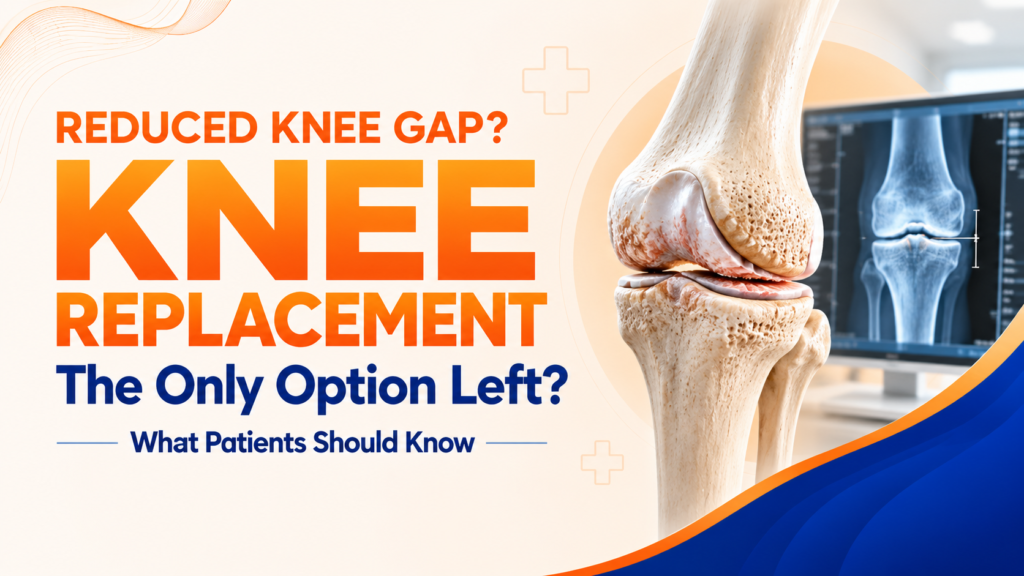
A reduced “gap” in the knee is a common finding on an X-ray, especially in people with knee osteoarthritis. Patients are often told that the space between the bones has decreased or that the knee has become “bone-on-bone,” which naturally raises an important concern:
Does reduced knee joint space mean knee replacement is now the only treatment option?
The answer is no—not automatically.
Reduced joint space is an important sign of joint degeneration, but the decision to undergo knee replacement should not be made from an X-ray alone. Symptoms, mobility, examination findings, severity of arthritis, overall health and response to previous treatments all matter.
What Does a Reduced “Gap” in the Knee Actually Mean?
The knee joint contains a layer of smooth articular cartilage that helps the ends of the thigh bone (femur) and shin bone (tibia) move against each other with minimal friction.
Cartilage itself is not clearly visible on a standard X-ray. Instead, doctors assess the space between the bones. When cartilage becomes thinner because of osteoarthritis, this joint space can appear narrower.
As arthritis progresses, the X-ray may also show changes such as bone spurs, increased density of the bone beneath the cartilage or changes in the shape and alignment of the joint.
Therefore, a reduced joint space generally suggests cartilage loss, but the X-ray finding must be interpreted together with the patient’s symptoms and clinical examination. AAOS describes osteoarthritis as progressive cartilage loss that can eventually expose the underlying bone surfaces.
Does Less Joint Space Always Mean Knee Replacement?
No.
Two patients can have similar-looking X-rays but experience very different symptoms.
One person with significant joint-space narrowing may still be able to walk, work and carry out most daily activities with manageable discomfort. Another person may experience severe pain, stiffness and disability.
For this reason, the amount of space visible on an X-ray is not, by itself, an indication for knee replacement surgery.
Knee replacement is generally considered when non-operative treatment is no longer providing adequate relief and the patient continues to have substantial pain and difficulty with activities of daily living.
What Can Be Tried Before Knee Replacement?
Depending on the stage of arthritis and the patient’s medical condition, several non-surgical approaches may still be appropriate.
These can include:
Exercise and physiotherapy to improve movement, strengthen the muscles supporting the knee and maintain function.
Weight management, particularly when excess body weight is increasing the load placed on the knee.
Activity modification, such as replacing high-impact activities with lower-impact exercise where appropriate.
Pain-relieving or anti-inflammatory medicines when medically suitable and prescribed or recommended appropriately.
Walking aids or selected knee braces in patients who may benefit from additional support.
Corticosteroid injections, which may provide short-term symptom relief in selected patients.
Other treatment options based on the cause, severity and pattern of arthritis.
Exercise, weight management, appropriate medications and selected assistive treatments are recognised components of non-operative knee osteoarthritis management.
These treatments do not necessarily restore cartilage that has already been lost. Their purpose is usually to control symptoms, maintain movement and improve function.
What If Only One Part of the Knee Is Damaged?
Not every arthritic knee requires a total knee replacement.
The knee contains different compartments. In some patients, arthritis is primarily limited to one part of the joint while the remaining areas are relatively preserved.
Depending on age, ligament function, alignment, activity level and the pattern of arthritis, a surgeon may consider other procedures.
For appropriately selected patients with isolated disease, partial knee replacement may be an option instead of replacing the entire joint. NICE recommends discussing partial and total knee replacement as alternatives in suitable patients with isolated medial-compartment osteoarthritis.
In certain patients, particularly where arthritis is concentrated on one side of the knee and alignment contributes to the problem, osteotomy may also be considered to redistribute forces through the knee.
These procedures are not appropriate for everyone, which is why identifying exactly where and how much of the knee is damaged matters.
When Does Knee Replacement Become a Reasonable Option?
Knee replacement becomes more relevant when arthritis has progressed to the point that symptoms significantly interfere with the patient’s quality of life.
A surgeon may consider knee replacement when there is a combination of factors such as persistent or severe knee pain, difficulty walking or climbing stairs, significant stiffness, limitation of routine activities, progressive deformity and inadequate relief despite appropriate conservative treatment.
The key point is that treatment should be based on the patient—not simply the X-ray.
Someone should not undergo knee replacement merely because a report says “joint space reduced.” At the same time, repeatedly delaying appropriate surgery when advanced arthritis is causing substantial disability may also leave the patient living unnecessarily with pain and restricted mobility.
Partial vs Total Knee Replacement
If surgery becomes necessary, the next question is whether the patient requires a partial or total replacement.
Partial Knee Replacement
Only the damaged compartment of the knee is replaced. This procedure is suitable only for selected patients where arthritis is sufficiently localised and other structures meet the necessary criteria.
Total Knee Replacement
In a total knee replacement, damaged joint surfaces are resurfaced and replaced with artificial components. It is commonly considered in patients with more extensive arthritis when symptoms significantly affect everyday function and other treatments are no longer adequate.
A detailed clinical examination and appropriate imaging help the surgeon determine which approach, if any, is appropriate.
Can Knee Replacement Be Avoided Forever?
This is the wrong goal for many patients.
The goal should not be to avoid surgery at any cost. The goal should be to use the most appropriate treatment at the right stage of the disease.
If symptoms are manageable and function remains good, non-surgical treatment may allow a patient to continue comfortably without replacement.
If the joint has become severely damaged and pain and disability remain substantial despite appropriate treatment, knee replacement may ultimately provide the more appropriate treatment option.
There is therefore no universal timeline.