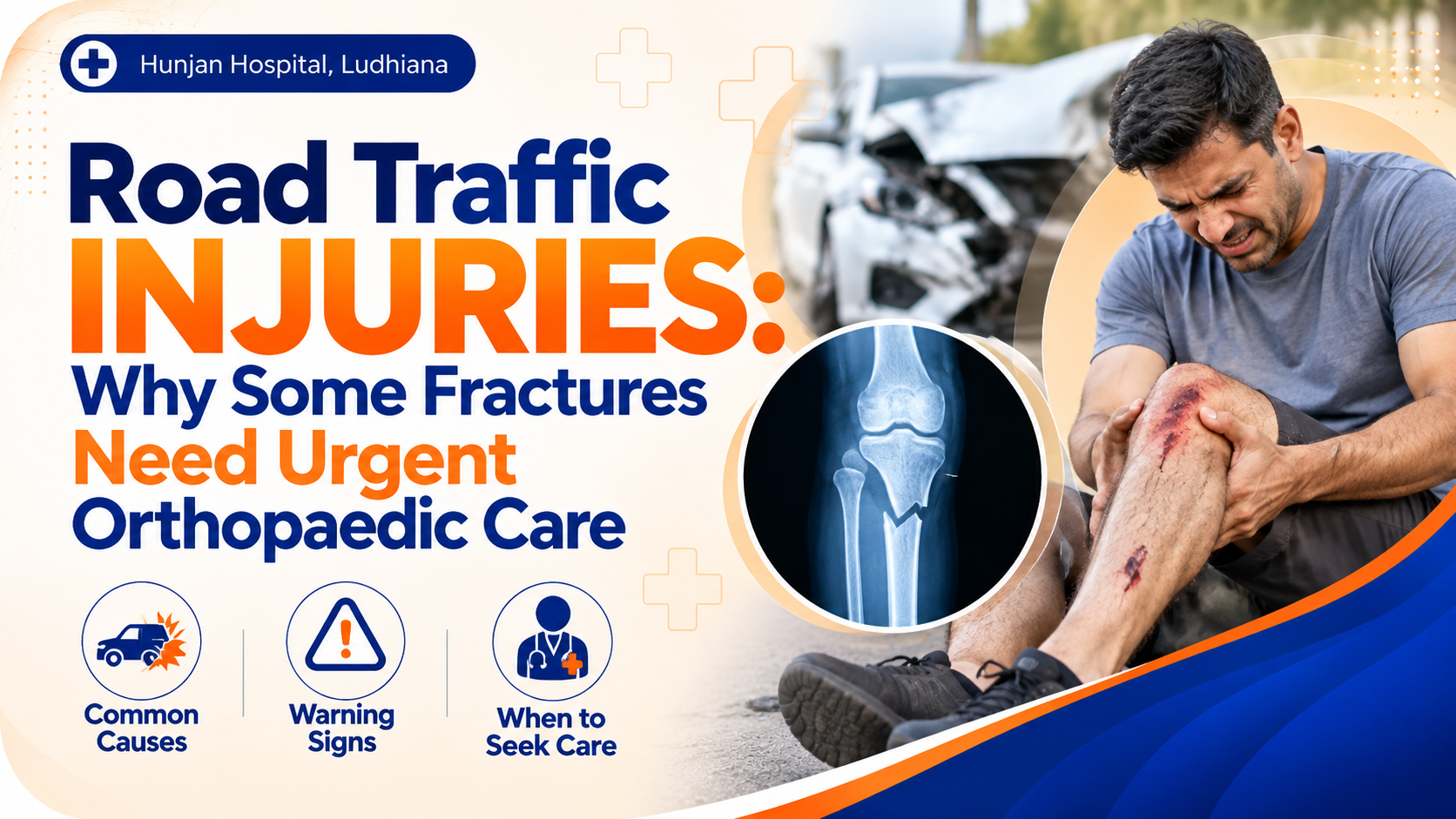
Road traffic accidents can cause injuries ranging from relatively minor soft-tissue damage to complex fractures involving bones, joints, nerves, blood vessels and surrounding tissues.
Because road traffic collisions can involve substantial force, an apparently obvious fracture may not be the patient’s only injury. Worldwide, road traffic injuries remain an important cause of serious injury and disability.
Why Are Some Road Traffic Fractures More Serious?
Not every fracture requires emergency surgery, but certain injuries need rapid medical assessment because delaying treatment could increase the risk of complications.
The urgency depends on the location and type of fracture, whether the bone has moved out of position, whether the skin is broken and whether nerves or blood vessels have been affected.
Open Fractures Require Prompt Treatment
An open fracture occurs when a fracture communicates with an external wound. The bone itself does not necessarily have to be visibly protruding from the skin for the injury to be classified as open.
These injuries require urgent medical care because contamination of the wound increases the risk of infection. Open fractures often require specialist orthopaedic management, antibiotics and surgical cleaning and stabilisation according to the nature of the injury.
Displaced and Unstable Fractures
Some fractures remain in relatively good alignment, while others cause the broken bone fragments to move significantly.
A severely displaced or unstable fracture may affect limb alignment, joint function and surrounding soft tissues. Depending on the fracture, treatment may require reduction and stabilisation using methods such as a cast, external fixation, plates, screws or intramedullary nails.
The correct treatment depends on the bone involved, fracture pattern, stability, soft-tissue condition and overall health of the patient.
Damage to Nerves or Blood Vessels
Following a fracture, doctors also assess circulation and nerve function beyond the injured area.
Warning signs such as a limb becoming pale, blue or unusually cold, persistent numbness, weakness or inability to move the fingers or toes require urgent assessment because they may indicate compromised circulation or nerve injury.
Why Severe Swelling Cannot Always Be Ignored
Swelling is common after fractures, but rapidly increasing swelling accompanied by severe or worsening pain, altered sensation or reduced circulation can indicate a more serious complication.
One emergency doctors consider after certain high-energy injuries is acute compartment syndrome, in which pressure builds within a closed muscle compartment. This requires urgent hospital assessment and, when confirmed, emergency treatment.
Fractures Around a Joint
Road accidents can also cause fractures around the knee, hip, ankle, shoulder, elbow or wrist.
These injuries require careful assessment because poor joint alignment or damage to the joint surface may affect future movement and increase the risk of stiffness or post-traumatic arthritis.
Some fractures around joints can be managed without surgery, while others require surgical fixation to restore alignment and stability.
When a road traffic accident causes significant damage to the knee joint, an orthopedic surgeon for knee replacement can evaluate the extent of the damage and determine whether surgical intervention may be required.
How Are Accident-Related Fractures Evaluated?
Trauma care starts with identifying and treating any immediate threats to life before focusing on individual fractures.
Once the patient is stable, assessment may include:
- Clinical examination
- Circulation and nerve assessment
- X-rays
- CT scans for selected complex injuries
- Evaluation for additional fractures or internal injuries
The treatment plan is then based on the complete injury pattern rather than only one X-ray finding.
For patients with significant knee damage following an accident, consulting an experienced orthopedic surgeon for knee replacement can help in understanding the available treatment options and determining the most appropriate approach based on the patient’s condition.
Warning Signs After an Accident
Urgent medical assessment is particularly important when there is:
- An obvious deformity
- Bone visible through a wound
- Severe or increasing pain
- Heavy bleeding
- Inability to use or bear weight on the injured limb
- Numbness or weakness
- A cold, pale or blue hand or foot
- Severe swelling
- Breathing difficulty or other signs of major trauma
A suspected fracture should not be forcefully straightened by an untrained person. The injured area should be supported and unnecessary movement avoided while appropriate emergency care is arranged.
The Important Message
Road traffic fractures are not all treated in the same way. Some can be managed with immobilisation and follow-up, while others require urgent surgery because of instability, open wounds, joint involvement, compromised circulation or associated trauma.
Early assessment by an appropriate trauma and orthopaedic team helps determine the safest treatment for each injury.
If an accident has resulted in severe knee joint damage and knee replacement is being considered, an orthopedic surgeon for knee replacement can assess the condition of the joint and discuss the most suitable treatment options.
Patients and their families should seek appropriate specialist evaluation when considering knee replacement after an accident. An orthopedic surgeon for knee replacement can review the patient’s medical history, imaging and overall condition before recommending a treatment plan.
Consultation & Registration
+91 85560 24365
Hunjan Hospital
111 Kochar Market Rd, South Model Gram, Ludhiana, Punjab 141002
Joint Replacement Package Information
₹90,000 is a starting package. Final cost may vary depending on medical evaluation, implant selection, patient condition and treatment requirements. T&C apply. Individual results may vary.
Medical Disclaimer
This article provides general educational information and is not intended to replace emergency medical care, diagnosis or treatment. Road traffic injuries may involve life-threatening or limb-threatening complications. Anyone with a serious accident, severe pain, deformity, open wound, heavy bleeding, numbness, loss of movement or changes in limb colour or temperature should seek urgent medical attention.